


For many Indians, some questions arrive long before adulthood.
“What do you want to become?”
“How were your marks?”
“When are you getting promoted?”
“When are you getting married?”
These questions often come from a place of care. Family members want the best for us. Teachers want us to succeed. Society celebrates achievement.
Yet somewhere between good intentions and high expectations, many people develop a constant inner voice that never quite goes silent.
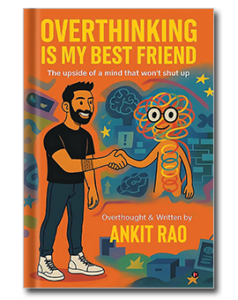
For Singapore-based author Ankit Rao, that voice became a lifelong companion—and eventually the inspiration behind his debut book, Overthinking Is My Best Friend.
Growing Up in a Culture of “What’s Next?”
Many Indians grow up learning that every decision matters.
Choosing the right subjects in school can shape college admissions. College choices can shape careers. Careers can shape financial security and social standing.
From an early age, people are encouraged to think ahead.
Sometimes several years ahead.
While this mindset can create ambitious and resilient individuals, it can also create a habit of constantly analyzing every possibility.
What if I choose the wrong path?
What if I disappoint my family?
What if everyone else is moving faster than I am?
For many people, these questions become part of daily life.
The Invisible Checklist Many People Live By
The interesting thing about expectations is that they do not always remain external.
Over time, they become internal.
Even when no one is asking questions anymore, the mind continues asking them.
Ankit experienced this firsthand.
Like many professionals, he carried invisible checklists about success, progress, and personal growth. There was always another milestone to reach and another comparison waiting around the corner.
Yet the more he observed his own thinking patterns, the more he realized that countless others were dealing with the same mental loops.
The pressure wasn’t always coming from outside.
Often, it was coming from within.
The Myth That Success Brings Mental Peace
Many people assume that once they achieve certain goals, the overthinking will stop.
A good job.
Financial stability.
Career growth.
A happy family life.
But reality is often more complicated.
New achievements simply bring new questions.
Am I doing enough?
Am I making the right choices?
What should come next?
As a technology leader living in Singapore, Ankit found that professional success did not automatically create peace of mind. Instead, it gave him new situations to analyze and new uncertainties to navigate.
That realization became one of the central themes of his writing.
The Overlooked Benefits of a Busy Mind
Overthinking is usually discussed as a weakness.
But Ankit believes there is another side to the story.
Many overthinkers are deeply self-aware. They pay attention to details. They reflect on experiences. They try to understand people, situations, and emotions more fully.
The same mind that creates worry can also create insight.
The same habit that leads to doubt can also lead to growth.
The challenge is learning how to work with that thinking process instead of constantly fighting it.
A Book for People Who Feel Seen Too Little
In Overthinking Is My Best Friend, Ankit shares personal stories from school, work, relationships, travel, and identity.
The book does not attempt to diagnose, fix, or transform readers.
Instead, it acknowledges something many people rarely hear:
You are not the only one having these thoughts.
Through humor, honesty, and self-reflection, the book creates space for readers to recognize themselves in its pages.
For those who have spent years wondering why their minds seem busier than everyone else’s, that recognition can be surprisingly powerful.
The Case for Rethinking Overthinking
Perhaps the phrase “you think too much” deserves a second look.
For many people raised in environments where every choice felt important, careful thinking became a survival skill.
It helped them prepare.
It helped them adapt.
It helped them move forward.
Of course, not every thought deserves attention. Not every worry deserves energy.
But dismissing all overthinking as a flaw may overlook something important.
Sometimes, behind the mental noise is a person trying to understand themselves, their future, and their place in the world.
And perhaps that isn’t weakness at all.
Perhaps it’s simply the result of caring deeply about getting life right.
