

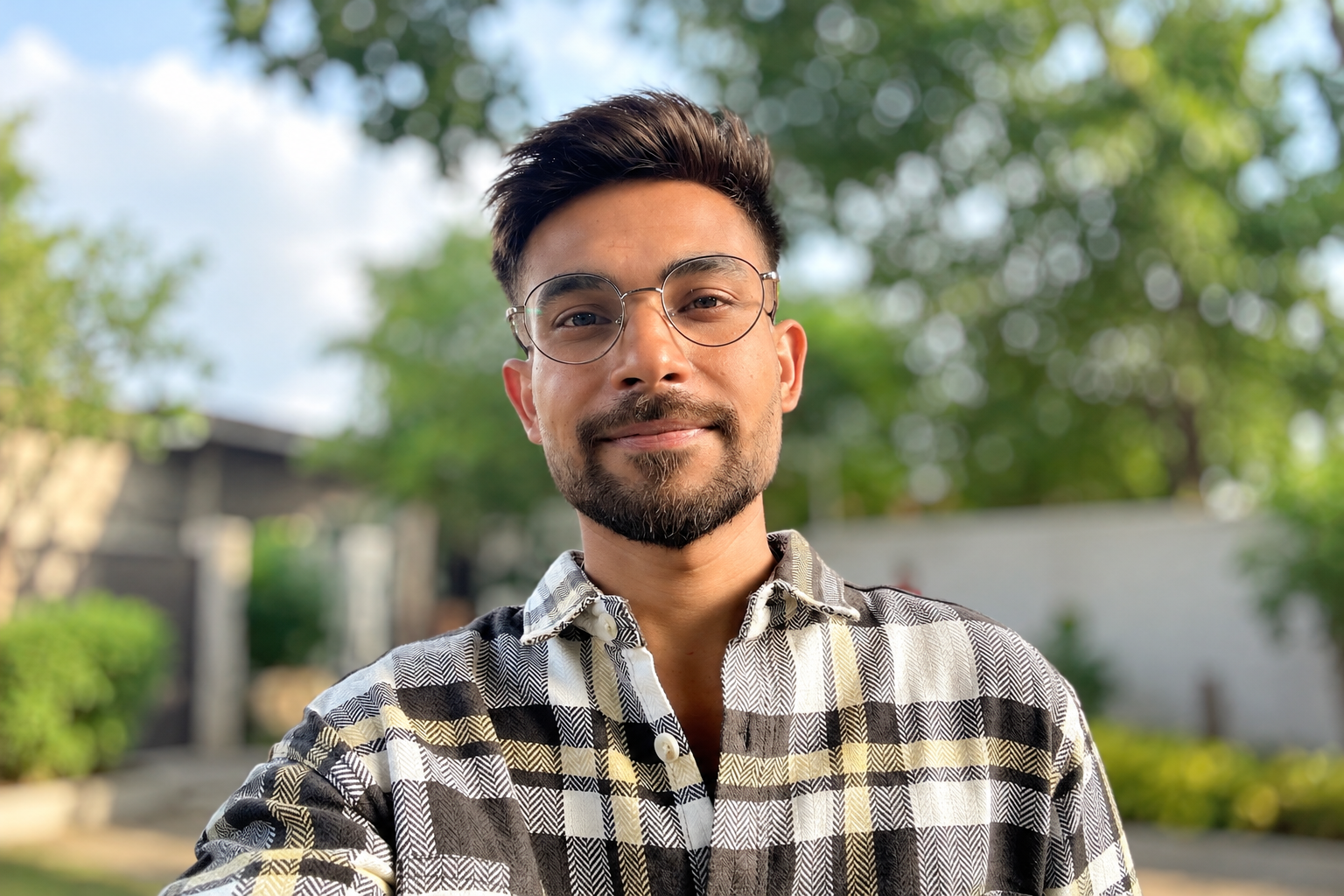
The Akola-born writer behind Echoes of Yesterday stopped publishing in 2024. He has returned with something his readers did not expect: a technology company built around the question of what AI assistants say about the businesses they recommend.
The last time Vaibhav Palhade’s name appeared on a book cover, the story inside began with a body. Echoes of Yesterday, published by Leadstart in August 2024, opens with an unidentified corpse in ancient clothing at a ruined fort in South India, and follows an engineer and a physician who are drawn backwards through time trying to explain it. At 453 pages, it was the most ambitious of his novels.
Then he went quiet. No new book in 2025. No short film. No festival entry. For a writer who had published steadily since 2020, the gap invited the usual assumption that he had stepped away.
He had not. He had changed the kind of problem he was working on.
Palhade is now a co-founder of Marketing Kernal, a young company working in a field the marketing industry has only recently started to name: AI visibility. The question at its centre is easy to state. When someone asks ChatGPT, Gemini or Perplexity to recommend a supplier, a school or a software product, which businesses get mentioned, and why?
“For two years people asked me what I was writing,” he says. “The honest answer was spreadsheets. Thousands of them.”
A long way round
Palhade grew up in Akola, in Maharashtra’s cotton-growing Vidarbha region, and trained as a computer engineer. The degree did not send him into a software company. It sent him, somewhat improbably, into the writers’ rooms and shooting floors of Mumbai’s entertainment industry, where he started as an assistant writer and assistant director. Over the following years he wrote screenplays and dialogue for Hindi films and series, and for Marathi daily soaps, the relentless format in which a writer may turn around an episode a day. Several of his films on social themes won awards.
Wider recognition came through fiction. Saajna Re and Crimson Breathe were both released in 2020, the year the pandemic kept much of India indoors and reading.
Alongside the writing, he built a career that rarely made it into his author biographies. For several years he worked in search engine optimisation and digital marketing, running growth programmes for software businesses selling into Britain and other overseas markets. It was unglamorous work, mostly data, and it is where he first noticed something changing.
“You could see the questions getting longer,” he says. “People stopped typing two words into Google and started typing whole sentences, the way you would ask a person. Then some of those questions simply stopped reaching websites at all.”
The pattern he describes has since been measured independently. In a study of the browsing behaviour of 900 American adults, published in July 2025, the Pew Research Center found that Google users clicked on a traditional search result in 8 per cent of visits when an AI-generated summary appeared, compared with 15 per cent when it did not. Links inside the AI summaries themselves were clicked about 1 per cent of the time.
For a business, the implication is uncomfortable. If the answer arrives before the click, the website is no longer where the decision is made.
The ventures that did not last
Palhade does not present Marketing Kernal as a first attempt. By his own count, three or four earlier ventures failed before it. He declines to name them, and he does not romanticise them either.
“Nothing dramatic happened,” he says. “We built things before checking anyone wanted them. We chased numbers that looked good in a meeting. We ran out of patience. It is a very ordinary way to fail, which is why it is worth remembering.”
What changed this time, he says, was the pace. With Pratyush Shrivastava, a Jaipur engineer whose own startup had also closed, he spent roughly two to three years researching before the company was formally set up in 2026. Their working notes, he says, began as a list of everything that had gone wrong before.
“We both arrived with scar tissue,” he says. “That turned out to be useful. You skip the optimism and go straight to the uncomfortable questions.”
From agency to ecosystem
Marketing Kernal currently offers consulting work in areas such as AI visibility, entity SEO and digital PR. But Palhade is more animated when he talks about software. The company is developing a group of products under the Kernal name. The first, and the only one Palhade will discuss by name, is Outreach Kernal, a B2B prospecting tool built to help companies find and research the right buyers using verified data rather than bulk contact lists. A beta version is expected in November, he says. The others remain under wraps, though he hints that one deals with how brands show up in AI answers and another with the sales conversations that follow. Tools for creative professionals, including independent filmmakers, are also on the list.
It is an ambitious slate for a company at this stage, and Palhade acknowledges as much. The products are at different points of development, the field itself is barely a few years old, and measuring what an AI model says about anyone is far from an exact science. Answers shift with phrasing, with the model, and from week to week.
“That is exactly why I distrust anyone who promises results here,” he says. “No one owns the answer. The model does. The most you can do is understand what it relies on and improve that honestly.”
The writer’s eye
Asked whether fiction prepared him for any of this, Palhade pauses before answering.
“A novelist spends years learning that every sentence has to earn its place,” he says. “An AI answer is the most ruthless editor I have ever met. A company might get one line. Sometimes none. My whole job now is understanding who gets that line.”
He has not given up writing, he says, though there is no new manuscript to announce. For now, the stories are in product documents. For a novelist whose last book was about how the past refuses to stay buried, the comeback has a certain logic. The failed ventures, the quiet years and the research were never really gone. They were material.
