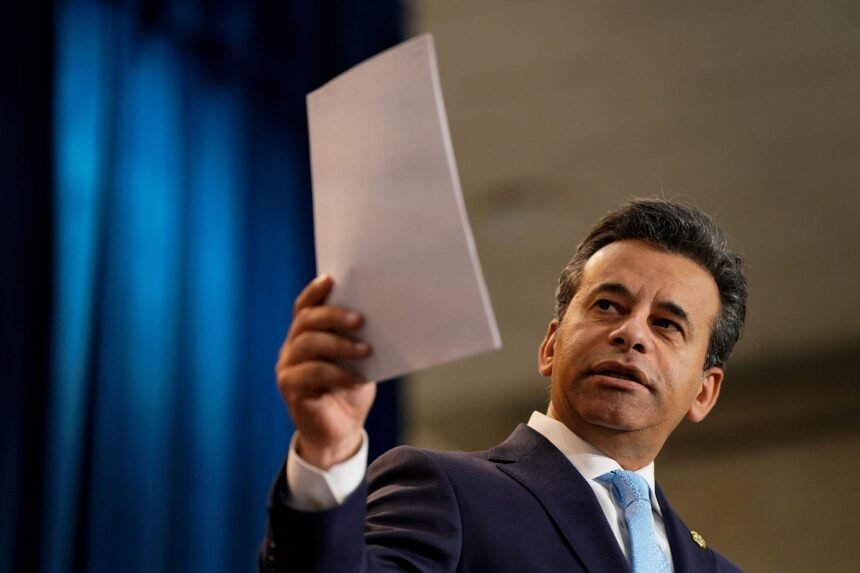
During a recent visit to Washington, D.C., I had the opportunity to sit down with Marty Makary, Commissioner of the U.S. Food and Drug Administration (FDA), at a time when the agency is navigating one of the most turbulent chapters in its recent history.
From leadership reshuffles and significant budget reductions to heated debates over vaccine policy and drug approvals, the FDA has found itself under intense scrutiny. Industry concerns have only grown following the agency’s shifting stance on Moderna’s flu vaccine application. Against this backdrop, Makary addressed several high-stakes issues shaping the pharmaceutical landscape.
A Firm Stance on Compounded GLP-1 Drugs
One of the most pressing matters involves the surge in compounded versions of GLP-1 medications — drugs originally developed for diabetes but now widely used for weight management.



Makary made it clear that the FDA is taking unlawful mass compounding seriously. The agency recently announced plans to act against Hims & Hers, which has been marketing compounded versions of Wegovy, originally developed by Novo Nordisk.
The FDA’s concern centers on quality, safety, and potential violations of federal law. Branded drugmakers, Makary emphasized, invest heavily in rigorous clinical trials and must adhere to strict marketing rules — including transparent disclosure of side effects. Compounded drugs, when mass-produced outside regulatory boundaries, may bypass those safeguards.
“Companies have to play by the rules,” Makary noted, explaining that the FDA is in direct communication with firms suspected of overstepping legal boundaries.
At the same time, he acknowledged that compounding itself is not inherently problematic. If active pharmaceutical ingredients (APIs) are sourced legitimately — such as directly from manufacturers like Novo Nordisk or Eli Lilly and Company — and compounded in accordance with federal regulations, increased competition could benefit patients.
Could 2026 mark the end of illegal large-scale GLP-1 compounding? Makary expressed hope — but stressed that compliance, not elimination, is the goal.
The Moderna Flu Shot Reversal
Another flashpoint is the FDA’s evolving position on Moderna’s experimental mRNA flu vaccine.



Shortly after our conversation, the FDA agreed to review Moderna’s flu shot application, reversing an earlier refusal. A final decision is expected in early August.
Makary refrained from signaling how the FDA might ultimately rule. Instead, he underscored the strength of the agency’s scientific guidance process. According to him, FDA scientists had clearly advised that participants aged 65 and older who did not receive Moderna’s vaccine should be given the “standard of care” comparator — specifically a higher-dose flu vaccine designed for seniors.
Moderna has pushed back, arguing that FDA guidance does not explicitly require the highest-dose comparator and that earlier written feedback suggested a standard flu shot would be acceptable.
On the broader question of mRNA technology — which has drawn both praise and criticism — Makary struck a measured tone. While expressing optimism about its potential in infectious diseases and even cancer treatments, he emphasized that enthusiasm must be grounded in robust clinical data.
The FDA, he said, will not “get ahead of the science.” Every application must meet established standards, regardless of political pressure or technological promise.
The China Challenge in Drug Development
Makary also turned attention to the global competitive landscape, particularly China’s growing dominance in early-stage drug trials.



China’s biotech sector has expanded rapidly, fueled by significant state investment, streamlined regulatory pathways, and strong academic partnerships. In contrast, Makary acknowledged that the United States faces procedural bottlenecks.
He identified three primary hurdles slowing American innovation:
-
Hospital contracting delays
-
Lengthy ethics review and approval processes
-
Increasingly complex Investigational New Drug (IND) applications
Over time, Makary argued, additional questions have been layered into the IND process without removing outdated or redundant ones. If certain compliance questions consistently receive the same affirmative answers, he suggested, regulators should reconsider whether they remain necessary.
The FDA, he said, is evaluating potential reforms, including partnerships with health systems and academic medical centers to accelerate the pre-IND process. The objective is not deregulation, but modernization — ensuring patient safety while restoring global competitiveness.
A Call for Bipartisan Collaboration
Throughout the discussion, Makary framed the FDA’s current challenges as an opportunity for reform. He described the effort to strengthen domestic innovation and regulatory efficiency as a bipartisan priority — one that requires collaboration between government and industry.
Rather than stifling competition abroad, he argued, the United States should focus on empowering its own ecosystem to deliver meaningful treatments and cures more efficiently.
As the FDA balances safety, scientific rigor, and global competitiveness, the coming year could prove pivotal. From compounded GLP-1 enforcement to vaccine evaluations and international biotech rivalry, the agency’s decisions will have lasting implications for patients, pharmaceutical companies, and public health alike.
In an era of uncertainty, Makary’s message was consistent: data first, rules enforced, and reforms designed to ensure both innovation and safety.