

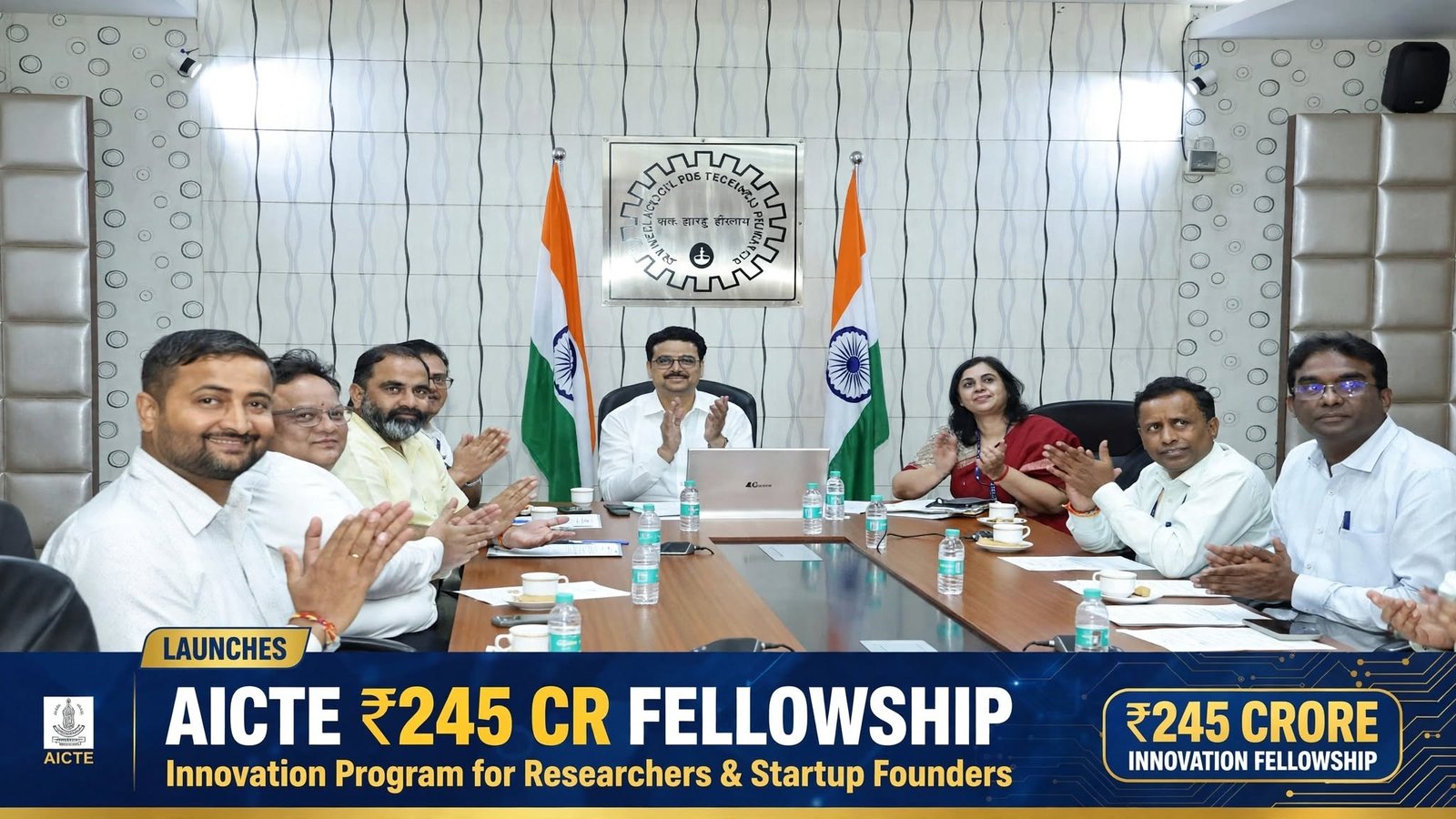
AICTE Launches ₹245 Crore Innovation Fellowship Program for Researchers and Startup Founders
AICTE ₹245 Cr Innovation Fellowship has been rolled out as the All India Council for Technical Education launches a major funding initiative aimed at supporting researchers, deep-tech innovators and early-stage startup founders across India.
The ₹245-crore program is designed to strengthen India’s innovation ecosystem by providing financial and institutional support to people working on research, emerging technologies and new business ideas.
The initiative comes as India continues to place greater emphasis on deep technology, research-led innovation and the development of startups capable of creating technology products with global applications.
AICTE Expands Support for Innovation
The All India Council for Technical Education plays an important role in India’s technical education ecosystem.
Through the new fellowship initiative, the council is seeking to connect academic research with practical innovation and entrepreneurship.
PhD researchers and technology innovators often require significant resources to develop ideas beyond the research stage.
Financial support can help researchers access equipment, conduct experiments, develop prototypes and pursue technology applications.
₹245 Crore Program Targets Multiple Groups
The fellowship program is aimed at several categories of innovators.
These include PhD researchers, deep-tech innovators and early-stage startup founders.
Each group represents an important part of India’s emerging innovation ecosystem.
PhD researchers contribute scientific and technical knowledge, while deep-tech innovators work on technologies that often require longer development cycles.
Startup founders, meanwhile, focus on converting technological ideas into products, services and commercially viable businesses.
Focus on PhD Researchers
Research scholars are expected to be an important beneficiary group under the initiative.
Developing new technologies can require years of experimentation before a commercially useful product emerges.
Financial assistance can help researchers continue their work without being limited by short-term funding constraints.
The program could also encourage more researchers to consider commercialization and entrepreneurship as potential pathways for their research.
Deep-Tech Innovation Gets Greater Attention
Deep technology has become an increasingly important part of India’s technology ambitions.
Areas such as artificial intelligence, robotics, advanced materials, biotechnology, semiconductors, quantum technologies and aerospace can require significant investment before reaching the market.
Unlike conventional software startups, deep-tech companies often face higher research and development costs and longer timelines.
Programs providing financial and institutional support can therefore play an important role in helping such ventures move from laboratories and prototypes toward commercial deployment.
Early-Stage Startup Founders Included
The fellowship program also targets early-stage startup founders.
New startups frequently face difficulties obtaining funding during their initial development stages, particularly when their products depend on significant research and technology development.
Support at this stage can help founders develop prototypes, validate technologies and build early versions of their products.
For technology-focused startups, access to institutional networks can also be valuable in addition to direct financial assistance.
Strengthening India’s Startup Ecosystem
India has developed one of the world’s largest startup ecosystems, but access to early-stage capital remains an important issue for many founders.
Government-backed initiatives can help bridge some of the gap between research and commercialization.
The AICTE program could create additional opportunities for innovators who may not yet have access to traditional venture capital.
This is particularly relevant for deep-tech companies, where investors may have to wait longer for commercial returns.
Connecting Academia With Industry
One of the broader goals behind innovation-focused programs is to strengthen the connection between universities and industry.
Academic institutions generate large amounts of research, but not every promising idea becomes a commercial product.
Fellowship and innovation programs can help researchers move their ideas toward practical applications.
Closer collaboration between researchers, startups and industry can also accelerate technology transfer and commercialization.
Importance of Deep-Tech Funding
Deep-tech innovation can have significant economic and strategic importance.
Technologies developed in areas such as artificial intelligence, semiconductor manufacturing, biotechnology and advanced engineering can influence multiple industries.
However, these sectors often require specialized talent, expensive infrastructure and extensive testing.
Funding programs can reduce some of the financial barriers faced by innovators during the early stages of development.
Potential Benefits for India’s Innovation Economy
The ₹245-crore initiative could have wider implications for India’s innovation economy if effectively implemented.
Supporting researchers and founders can potentially lead to more patents, prototypes, technology startups and commercially viable products.
Successful deep-tech ventures can also create highly skilled employment and attract additional private investment.
Over time, this could contribute to the development of stronger technology clusters around universities, research institutions and startup hubs.
AICTE’s Role in Technical Innovation
AICTE’s involvement provides the initiative with a connection to India’s large technical education network.
Engineering and technical institutions are important sources of research talent and future entrepreneurs.
Students, researchers and faculty members working on technology projects can potentially benefit from greater access to innovation-focused programs and institutional support.
This could help create a stronger pipeline from technical education to research and entrepreneurship.
From Research to Commercialization
A major challenge for innovation ecosystems is converting scientific discoveries into commercially useful products.
Researchers may develop promising technologies but lack experience in business development, intellectual property management, fundraising or market validation.
Startup-focused support can help bridge these gaps.
If the AICTE initiative succeeds in connecting technical talent with entrepreneurship resources, it could help more innovations move from academic environments into the marketplace.
India Pushes Toward Technology-Led Growth
The fellowship program also fits into India’s broader focus on technology-led economic development.
The country is increasingly seeking to develop domestic capabilities in advanced technologies rather than depending entirely on imported solutions.
Encouraging researchers and startups to develop indigenous technologies can support this objective.
Deep-tech companies can also potentially serve global markets, creating opportunities for Indian technology products beyond the domestic economy.
What Participants Could Gain
Depending on the specific structure and eligibility requirements of individual fellowship components, participants could receive financial assistance and access to institutional innovation networks.
For researchers, this could support continued technical development.
For founders, support could help accelerate early-stage product development and validation.
The exact benefits, selection criteria and application procedures will determine how widely the program can support India’s innovation community.
What Happens Next?
The implementation of the AICTE fellowship program will be closely watched by researchers, academic institutions and startup founders.
Potential participants will need to review official eligibility criteria, application deadlines and program-specific requirements before applying.
The effectiveness of the initiative will ultimately depend on how funding reaches promising projects and whether recipients receive the additional support needed to turn ideas into scalable technologies.
Key Takeaway
The AICTE ₹245 Cr Innovation Fellowship represents a significant push to support India’s research and technology ecosystem.
The ₹245-crore program targets PhD researchers, deep-tech innovators and early-stage startup founders, providing a potential bridge between academic research, technological experimentation and commercial entrepreneurship.
As India continues to expand its focus on artificial intelligence, deep technology and research-led startups, initiatives of this scale could help strengthen the pipeline of innovators developing the country’s next generation of technology solutions.
FAQs
1. What is the AICTE ₹245 Cr Innovation Fellowship?
It is an innovation-focused fellowship program launched by the All India Council for Technical Education with a total allocation of ₹245 crore.
2. Who is the AICTE fellowship aimed at?
The program targets PhD researchers, deep-tech innovators and early-stage startup founders across India.
3. Why is the fellowship important for PhD researchers?
Financial support can help researchers continue experiments, develop prototypes and explore practical applications of their research.
4. What is deep-tech innovation?
Deep-tech innovation involves technologies based on significant scientific or engineering research, such as artificial intelligence, biotechnology, robotics, quantum technologies and advanced materials.
5. Will startup founders be eligible?
Early-stage startup founders are among the groups targeted by the initiative, subject to the program’s specific eligibility and selection requirements.
6. How much funding has been allocated?
The overall program has an allocation of ₹245 crore.
7. Can the program help Indian deep-tech startups?
The initiative is designed to support deep-tech innovators and early-stage founders, potentially helping them develop technologies and move toward commercialization.
8. Why does India need more deep-tech funding?
Deep-tech projects often require significant research, specialized infrastructure and longer development periods, making early-stage funding particularly important.
9. How can researchers benefit from innovation programs?
Researchers can potentially use support to develop prototypes, conduct experiments and explore commercial applications for their technologies.
10. Where can applicants find official fellowship information?
Applicants should check official AICTE announcements and program documentation for eligibility requirements, application procedures, deadlines and other details.
