

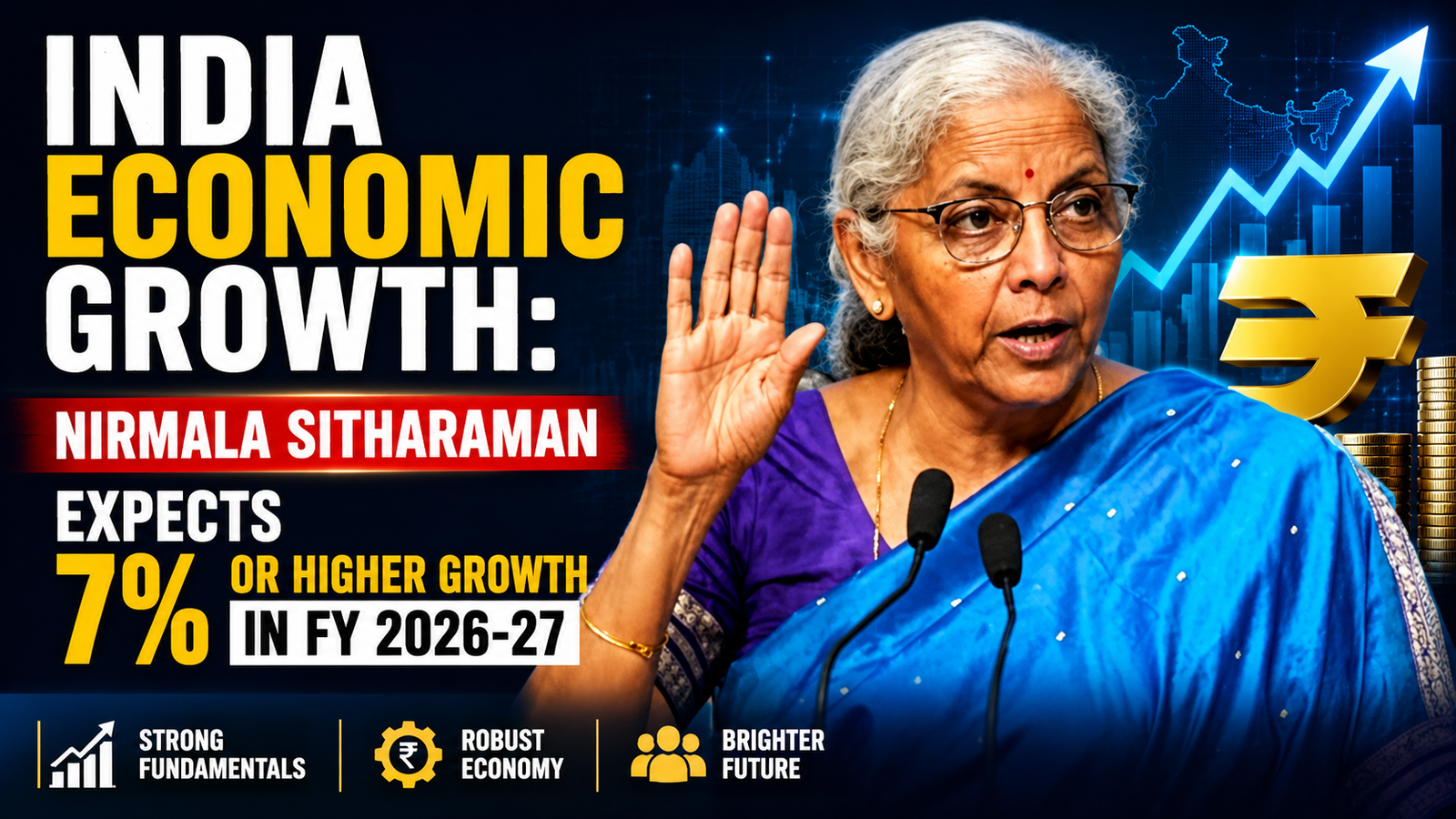
India Economic Growth: Nirmala Sitharaman Expects 7% or Higher Growth in FY 2026-27
India economic growth is expected to remain strong in the financial year 2026-27, with Finance Minister Nirmala Sitharaman saying that the country’s economy is likely to sustain a growth rate of 7% or higher despite continuing geopolitical uncertainties.
Sitharaman made the remarks while addressing members of the Indian diaspora in Chicago, highlighting the resilience of the Indian economy at a time when global markets continue to face uncertainty.
Her comments come as investors, businesses and policymakers around the world continue to monitor geopolitical developments, global trade conditions and their potential impact on economic activity.
India Economic Growth Expected to Stay Above 7%
According to Finance Minister Nirmala Sitharaman, India economic growth is likely to remain at 7% or above during FY 2026-27.
The projection reflects confidence in the underlying strength of the Indian economy and its ability to maintain momentum despite challenges coming from the global environment.
India has remained one of the faster-growing major economies, supported by domestic consumption, investment activity, infrastructure development and the expansion of several emerging sectors.
Maintaining growth above 7% would further strengthen India’s position among the world’s major economies.
Nirmala Sitharaman Highlights Economic Resilience
While speaking to the Indian diaspora in Chicago, Sitharaman pointed to India’s ability to sustain economic growth even as geopolitical uncertainty remains a concern.
Global economic conditions can have a direct impact on countries through trade, investment, commodity prices, supply chains and financial markets.
Despite these risks, the Finance Minister’s assessment suggests that India’s domestic economic fundamentals could help the country maintain a relatively strong growth trajectory.
The comments also reflect the government’s confidence in India’s medium-term economic outlook.
Why 7% Growth Matters for India
A sustained growth rate of 7% or higher can have significant implications for the Indian economy.
Strong economic expansion can support job creation, encourage investment and increase demand for goods and services.
It can also provide the government with greater fiscal capacity to invest in infrastructure and public services.
For businesses, a growing economy can create opportunities to expand operations, enter new markets and increase capital expenditure.
This makes the outlook for India economic growth important not only for policymakers but also for companies and investors.
Domestic Demand Remains Important
One of the key strengths of the Indian economy is its large domestic market.
Consumer spending forms an important part of economic activity, while rising incomes, urbanisation and changing consumption patterns continue to influence demand.
A relatively strong domestic economy can provide some protection when external conditions become uncertain.
This is particularly relevant at a time when global trade and geopolitical developments remain difficult to predict.
Infrastructure and Investment Can Support Growth
Infrastructure development has also become an important part of India’s economic strategy.
Investment in roads, railways, airports, logistics networks, digital infrastructure and urban development can support economic activity across multiple sectors.
Infrastructure spending can create demand for construction materials, engineering services, manufacturing and transportation.
Over time, better infrastructure can also improve productivity and make it easier for businesses to operate.
Geopolitical Uncertainty Remains a Challenge
The positive growth outlook comes despite significant geopolitical uncertainty around the world.
Conflicts, changing international alliances, trade restrictions and disruptions to global supply chains can all affect economic growth.
Higher energy prices can also create additional pressure for countries that import large quantities of crude oil and other commodities.
For India, managing these external risks while maintaining domestic momentum will remain an important economic challenge.
India’s Position in the Global Economy
India’s economic performance has become increasingly important to the global economy.
As one of the world’s largest economies, sustained Indian growth can contribute to global demand and investment.
International companies are also increasingly looking at India as a major market and manufacturing destination.
The country’s expanding digital economy, growing infrastructure and large consumer base continue to attract global attention.
What Strong Economic Growth Could Mean for Businesses
Businesses generally benefit from a growing economy because higher economic activity can translate into stronger demand.
Consumer-facing companies may benefit from increased spending, while industrial businesses can gain from higher investment and infrastructure activity.
Financial services, technology, manufacturing, logistics and other sectors can also benefit when companies and consumers increase spending.
However, businesses will still need to navigate global risks, inflation, interest rates and changes in international trade conditions.
Impact on Investors
The economic growth outlook is also relevant for investors.
Strong GDP growth can support corporate earnings and investment activity over the longer term.
However, economic growth alone does not guarantee positive stock market performance. Markets are influenced by several other factors, including valuations, interest rates, global markets, corporate earnings and investor sentiment.
Therefore, the 7% or higher growth outlook should be viewed as a broader economic indicator rather than a direct prediction of stock market performance.
India’s Long-Term Growth Story
India’s growth story has increasingly been linked to structural changes within the economy.
Digitalisation, formalisation, infrastructure investment, manufacturing expansion and the growth of new-age businesses are reshaping economic activity.
Government initiatives aimed at improving domestic manufacturing and attracting investment are also intended to strengthen India’s productive capacity.
If these trends continue, they could support economic growth over the longer term.
Challenges That Could Affect Growth
Despite the optimistic outlook, several risks could affect India’s growth rate.
Global economic slowdowns, geopolitical tensions, commodity price volatility and disruptions to international trade could create challenges.
Domestic factors such as inflation, interest rates, employment conditions and private investment will also remain important.
The ability to manage these challenges will determine whether India can sustain growth at the levels highlighted by the Finance Minister.
What to Watch in FY 2026-27
Economic indicators during FY 2026-27 will provide a clearer picture of how India’s growth trajectory is developing.
Investors and policymakers will closely monitor GDP figures, inflation, industrial production, consumer spending, exports, imports and investment trends.
The performance of key sectors such as manufacturing, services, construction and technology will also be important.
Together, these indicators will determine whether India’s economy can maintain the pace expected by the government.
India Economic Growth: Key Takeaway
The outlook for India economic growth remains positive, with Finance Minister Nirmala Sitharaman expecting the country to sustain a growth rate of 7% or higher in FY 2026-27.
Her comments in Chicago reflect confidence in India’s economic fundamentals despite geopolitical uncertainty and a challenging global environment.
Strong domestic demand, infrastructure investment, expanding digital activity and growing business opportunities could continue to support economic momentum.
However, global trade conditions, energy prices and geopolitical developments remain important risks.
The coming financial year will show whether India can maintain the high growth trajectory outlined by the Finance Minister.
Frequently Asked Questions (FAQs)
1. What is the expected India economic growth rate for FY 2026-27?
Finance Minister Nirmala Sitharaman said India is likely to sustain an economic growth rate of 7% or higher during FY 2026-27.
2. Who gave the latest growth outlook for India?
The growth outlook was given by Finance Minister Nirmala Sitharaman while addressing the Indian diaspora in Chicago.
3. Why is India expected to maintain strong growth?
Factors such as domestic consumption, investment, infrastructure development, digitalisation and activity across major sectors can support India’s economic growth.
4. Could geopolitical tensions affect India’s growth?
Yes. Geopolitical tensions can affect energy prices, international trade, investment flows and global supply chains, potentially creating risks for India’s economy.
5. Why is 7% economic growth important for India?
Sustained growth at 7% or higher can support investment, employment, consumer demand and infrastructure development while strengthening India’s position in the global economy.
6. How does economic growth affect businesses?
Higher economic activity can increase demand for goods and services, create investment opportunities and encourage businesses to expand.
7. Does 7% GDP growth guarantee a rising stock market?
No. Stock markets are influenced by many factors, including corporate earnings, valuations, interest rates, global markets and investor sentiment.
8. What sectors could benefit from India’s economic expansion?
Manufacturing, infrastructure, technology, financial services, logistics, construction and consumer-focused businesses could benefit from sustained economic activity.
9. What risks could affect India’s FY 2026-27 growth?
Major risks include geopolitical uncertainty, global economic weakness, commodity price volatility, inflation, changing interest rates and disruptions to international trade.
10. What will determine India’s actual growth rate?
GDP data, consumer spending, investment, industrial production, exports, imports, inflation and the performance of major economic sectors will help determine India’s actual growth rate during FY 2026-27.
