

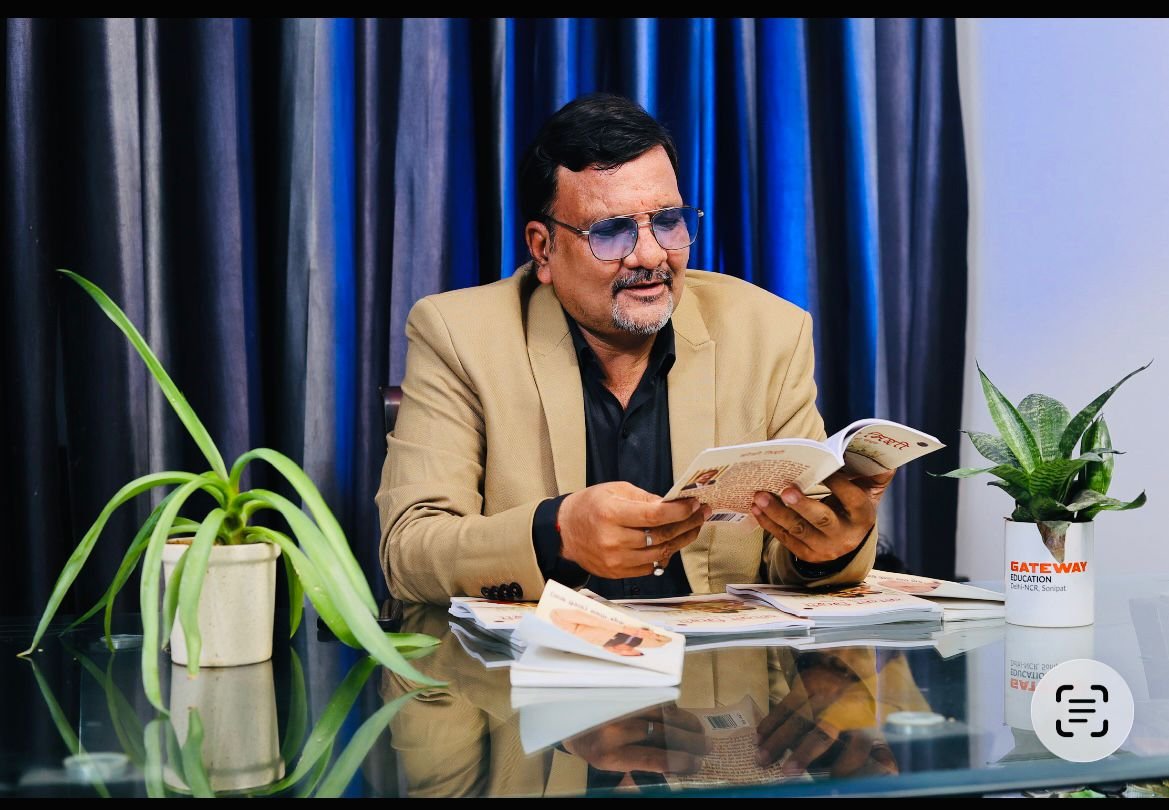
In a world where almost every word ever written is now typed, copied, or generated by a machine, Piyush Goel is doing something almost no one else on the planet attempts. He is hand-writing entire books, in mirror image, using objects most people would never associate with writing at all.
Needles. Iron nails. Mehndi cones. Carbon paper. Fabric cone liners. Correction pens. Wooden pens on magic sheets. Each completed book is a feat of patience, precision, and craft that turns the act of writing back into something it has not been for centuries, which is genuinely difficult.
The media calls him the Mirror Image Man of India. The world record books call him a record holder. People who have watched him work for hours over a single page tend to use a simpler word. Unreal.
A Mechanical Engineer Who Became a Literary Phenomenon
Piyush Goel was born on 10 February 1967 in a middle-class family to his mother, Smt. Ravikanta Goel, and his father, Dr. Devendra Kumar Goel. He trained as a mechanical engineer and built a 29-year career in the corporate world, holding down a full-time job while quietly doing something extraordinary on the side.
He is also a cricket umpire at the regional level, a mathematician with three research papers published in international journals, a motivational speaker who has addressed more than 10,000 students free of charge, a cartoonist, and a short story writer published in regional languages. But the work that has defined his name globally is the mirror image writing.
What Mirror Image Writing Actually Is
Most people first encounter mirror image writing through Leonardo da Vinci’s notebooks. Da Vinci famously wrote his private journals in reverse, readable only when held up to a mirror. It is one of the hardest forms of writing to master. Every letter has to be reversed in the mind, then placed correctly on the page, in a sequence that runs right to left for a reader who reads left to right.
Piyush Goel does this in two languages, Hindi and English. He has been refining the skill since he was a child. And he has used it to hand-write 19 books, with a 20th currently in progress.
The Tools That Made Him a World Record Holder
This is the part that makes Piyush Goel’s work unlike any other author’s. The choice of tool is part of the art.
His most famous work is the world’s first needle-written book, Madhushala by Harivansh Rai Bachchan. He hand-wrote the entire text using a needle, puncturing the words into the paper letter by letter, in mirror image. The book made history. The World Record Association certified it. The Limca Book of Records has recognised his work twice.
The full list of objects he has used to write books reads like a deliberate challenge to anyone who thinks writing only happens with a pen. Beyond the needle for Madhushala, he has used a mehndi cone to write Rabindranath Tagore’s Gitanjali, an iron nail to write his own work *Piyush Vaani*, carbon paper to write Vishnu Sharma’s Panchatantra, and fabric cone liner, correction pen, and wooden pen on a magic sheet for others.
Three of his books are preserved at the Vrindavan Research Institute. Ten of his books have been formally published.
The 20th Book and Why It Matters
Piyush Goel is currently working on his 20th book. He is hand-writing Ramdhari Singh Dinkar’s *Rashmirathi*, the celebrated Hindi epic on Karna from the Mahabharata, in mirror image using coloured pencils.
The choice of subject is telling. Rashmirathi is one of the most emotionally charged works in modern Hindi literature, and reproducing it by hand in mirror image with coloured pencils is the kind of project that takes months of daily, painstaking work. For someone who has been at this craft for more than two decades, the ambition has only grown.
A Trail of Awards and National Recognition
The recognition for Piyush Goel’s work has been steady and substantial. Beyond the two Limca Book of Records entries and the World Record Association certification, his shelf of awards now includes the Dr. Sarvepalli Radhakrishnan Award (2021 and the 3.0 Excellence edition in 2025), the Indian Besties Award (2021), the Fanatixx Spectrum Award, the Criticspace Literary Award (2022), the Hind Shiromani Samman (2023), the Kabir Kohinoor Samman (2023), the Munshi Premchand Samarpan Samaj Gaurav (2024), the Rashtriya Gaurav Samman (2024 and 2025), the 27th International Juno Award (2024), and most recently the Rashtriyahit Seva Atal Samman in 2026.
That is more than 15 major awards across art, literature, motivation, and national service. Few authors in India have built that kind of recognition for a single, singular craft.
Why This Matters in 2026
Piyush Goel’s work is doing two things at once. It is preserving the discipline of handwriting at a moment when handwriting itself is becoming obsolete. And it is reminding readers that some forms of creativity cannot be shortcut, cannot be generated, and cannot be faked.
A needle puncturing each letter of Madhushala through paper, in mirror image, page after page after page, is the kind of thing no AI will ever replicate. It requires a human hand, a human attention span, and a human willingness to spend months on something that could be typed in minutes.
In an age increasingly defined by speed and automation, that quiet patience is exactly what makes Piyush Goel, the Mirror Image Man of India, one of the most remarkable working authors in the country today.
