

There is a patent sitting in a public database that most people have never read. Filed by Apple in January 2022 and published by the US Patent and Trademark Office in July 2023, it carries one of the more quietly significant titles in recent technology history: “Biosignal Sensing Device Using Dynamic Selection of Electrodes.”
The title is deliberately unassuming. Patents often are. But read past the technical language and what you find is this: a detailed framework for embedding EEG; electroencephalography; sensors into earbuds. Electrodes placed in and around the ear canal, designed to read the electrical activity of your brain.
Not your heart rate. Not your steps. Not your sleep. Your thoughts.
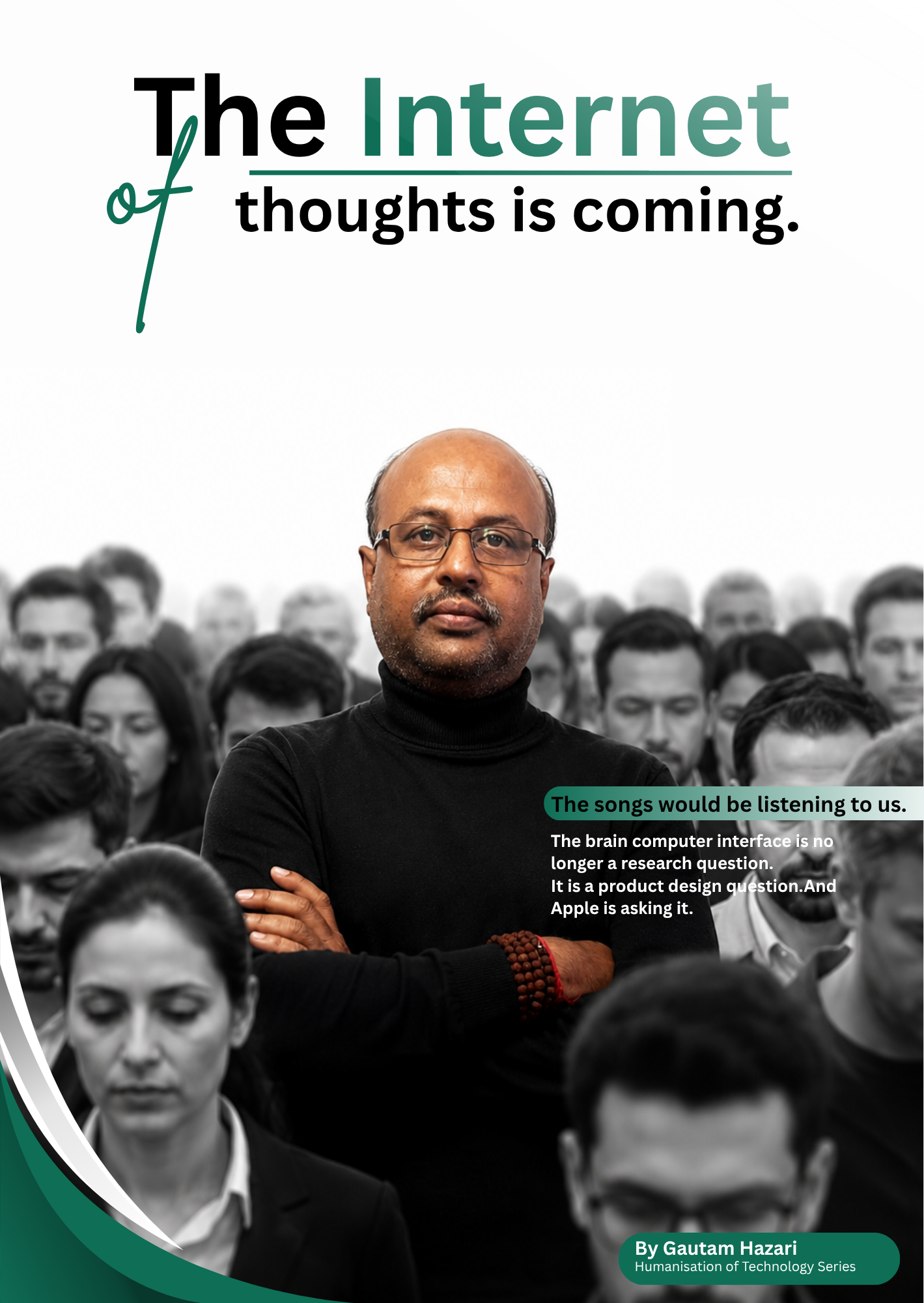
For the first time in the history of music; it would not just be that we are listening to the songs. The songs would be listening to us.
Imagine not needing to skip a song you dislike. The earbud senses the thought before your finger reaches the button. The machine learning model; trained on the accumulated patterns of your preferences, your moods, your cognitive states; has already moved on. And with each passing track, it learns more. Not about what you click. About what you feel.
This is not science fiction. It is the logical extrapolation of a patent filed by one of the world’s most valuable companies, in a form factor already worn by more than 120 million people globally.
I call what comes next the Internet of Thoughts; the IoTh. And understanding where it leads requires us to first understand where we have already been.
From Reading to Writing: The Arc of Every Internet
Every major phase of the internet has followed the same arc. It begins with reading. Then it becomes writable. Then the implications of that writability catch us off guard.
The World Wide Web arrived in 1989 as a read-only environment. Web 1.0 was a library. You consumed what was there. Then, around 2004 and 2005, the mobile phone made the internet personal and the web became writable. Users started uploading, posting, sharing. Social media industrialised that impulse. Today, 95 million photos and videos are posted to Instagram every single day. 5.5 billion snaps are created on Snapchat in that same 24 hours. We are now producing more content than any human being could ever consume; and it is reordering our psychology in ways we are only beginning to measure. Our average attention span, according to research published in recent years, has fallen to 8.25 seconds. The goldfish, famously, holds its focus for 9.
The Internet of Things followed the same pattern. IoT began by reading the physical world; temperature, motion, altitude, proximity. Sensors telling us what was happening. Then it became writable. Actuators received instructions. Motors moved. Switches opened. A LIDAR system on an autonomous vehicle reads an obstacle and writes a braking command in milliseconds. The read-write loop is what makes a system truly intelligent.
The Internet of Thoughts will follow this same arc. And it is the write phase of that arc that should command our most serious attention.
The Read Phase Is Already Beginning
Apple’s patent describes what is technically known as ear-EEG; electroencephalography conducted not from electrodes on the scalp, as in a clinical setting, but from the surface of the ear canal. The advantages are practical: ear-worn sensors are less visible, more stable during movement, and far more comfortable for extended use than anything resembling a medical device.
The system Apple describes uses multiple electrodes simultaneously, with an AI model that dynamically selects the strongest signal in real time; adapting to the unique anatomy of each user’s ear, continuously optimising accuracy without requiring any intervention from the person wearing it.
Portable EEG devices are not new. Headbands like Muse have been available for years, allowing users to receive biofeedback on cognitive states; primarily to support meditation, providing real-time signals of mental calm or agitation. But the form factor has always been the barrier. A headband is a statement. It is another device to remember, another thing to charge, another object that marks you out as someone doing something deliberate. It does not sit quietly inside the fabric of daily life.
AirPods do. And that changes everything about the calculus of adoption.
The brain-computer interface market is already significant and growing rapidly. Estimates for 2026 put it between one and four billion dollars depending on the scope of measurement, with consistent projections of double-digit annual growth through the next decade. Neuralink has implanted BCIs in human patients. Synchron’s minimally invasive stent-like device has already enabled an ALS (Amyotrophic lateral sclerosis ) patient to control his smart home using direct neural signals. These are clinical and invasive applications. Apple’s patent points toward something categorically different: passive, continuous, consumer-grade neural sensing, worn without thought, in a device people already love.
The brain-computer interface is no longer a research question. It is a product design question. And Apple is asking it.
The Write Phase Is the Question We Are Not Asking
Here is where intellectual honesty requires us to go somewhere uncomfortable.
If the IoTh follows the arc of every internet that came before it; and there is no structural reason to think it will not; the read phase will be followed by a write phase. And the write phase of a network connected directly to human cognition is a different order of risk from anything we have navigated before.
Consider what that might mean concretely. I am walking past a fast-food restaurant. An application has geo-located my position. It knows, from my neural profile, that I am experiencing low blood sugar; a physical state that correlates with certain brain-signal patterns. It writes a signal to my earbuds. A prompt. A suggestion; indistinguishable, at the level of felt experience, from my own appetite. And I find myself walking through the door, certain that I was hungry, with no awareness that the hunger was manufactured, synthetic.
Or consider the political version. An application, having profiled my ideological inclinations from years of online behaviour, uses neural stimulation through my earbuds to amplify or redirect those inclinations in the days before an election. Not persuasion in the traditional sense; not an argument I can evaluate or a message I can choose to ignore. Something quieter. A nudge applied directly to the machinery of preference.
This is not a Black Mirror episode. It is the write phase of a technology whose read phase is already being patented.
The Governance Gap Has a History
We have been here before. The original internet was built without an identity layer. That omission; the decision not to engineer trust and accountability into the infrastructure from the beginning; is still costing us. According to the FBI, internet crime losses exceeded sixteen billion dollars in 2024. The most reported category of fraud, by volume, was impersonation. And despite decades of warnings, the most popular password in the world remains “123456”; one that security researchers estimate can be cracked in under a second.
We patched the identity gap with passwords. Then with two-factor authentication. Then with biometrics. Each layer added after the fact, each one representing the cost of building a system without thinking hard enough at the beginning about the humans who would use it and the adversaries who would exploit it.
Now, generative AI is compromising even the biometric layer. Voice can be cloned from twenty seconds of audio. Faces can be synthesised with accessible tools. The identity crisis of the original internet is not solved; it is accelerating.
The Internet of Things repeated the same mistake. IoT devices were shipped with default passwords, no encryption, no meaningful security architecture. The consequences were predictable and severe. Botnets built from compromised home routers. Ransomware delivered through connected medical devices. In 2016, the Mirai botnet used IoT devices to deliver one of the largest distributed denial-of-service attacks ever recorded.
We cannot afford to repeat this pattern with the Internet of Thoughts. The stakes are categorically higher. Because the asset at risk is not your data. It is your mind.
The Regulation Is Starting; But Barely
Legislators are beginning to move. In the United States, four states had enacted neural data privacy laws by mid-2025, with more bills introduced at state and federal level through 2026. Colorado, California, Montana, and Connecticut have each amended their privacy frameworks to define neural data as a distinct and sensitive category; one that requires heightened consent and explicit limits on use.
In September 2025, Senators Schumer, Cantwell, and Markey introduced the MIND Act; the Management of Individuals’ Neural Data Act; directing the FTC to study how neural data should be governed, identify gaps in existing law, and recommend a regulatory framework that protects privacy while enabling responsible innovation.
UNESCO announced a global framework for neurotechnology standards in Paris in November 2025, establishing ethical and legal guardrails for technologies capable of reading, decoding, or altering neural activity. The Spanish Data Protection Authority and the European Data Protection Supervisor released a joint report on the implications of neurotechnology under EU data protection law, flagging neural data as potentially qualifying as a special category requiring the highest levels of protection.
This is progress. But it is early, fragmented, and reactive. The regulatory patchwork that is emerging bears an uncomfortable resemblance to the early days of social media governance; frameworks that arrived years after the architecture of the systems they were trying to regulate had already been locked in.
The question is not whether the Internet of Thoughts will arrive. It is whether we will build the governance infrastructure before or after the harm.
What Humanising the Internet of Thoughts Requires
The humanisation of technology is not an aesthetic preference. It is a design imperative. It means asking, before the architecture is built, what happens to the human being at the centre of this system. Not just the capable, informed, consenting adult that product designers imagine. The vulnerable person. The child. The elderly. The person who does not understand what they signed up for. The person who cannot opt out because the technology has become so embedded in ordinary life that opting out means being left behind.
For the Internet of Thoughts, humanisation demands three things.
First: that the identity layer is built in from the beginning. Not retrofitted. Not patched after the first breach. The governance architecture; who can read what, who can write what, under what conditions, with what consent, auditable by whom; must precede the commercial deployment. We have no more excuses for getting this wrong. We have done it wrong twice already.
Second: that the distinction between reading and writing is treated as a fundamental ethical line. Reading neural data for health monitoring, for accessibility applications, for the kind of genuine human benefit that makes technology worth building; that is a conversation worth having carefully. Writing to neural systems; stimulating, nudging, redirecting cognition without explicit, granular, revocable consent; must be treated not as a product feature but as a matter requiring the kind of regulatory seriousness we apply to pharmaceutical interventions in the brain.
Third: that this conversation happens in public, now, while the technology is still in the patent stage and not yet in the product stage. History tells us that once a technology achieves the scale of 120 million devices, the governance conversation becomes reactive by definition. The moment to set the terms is before the terms are set for us.
A Final Thought
There is something quietly extraordinary about the fact that we are having this conversation at all; that a patent filed in 2022 and published in 2023 can serve as a starting point for a debate about cognitive sovereignty that will define the next phase of the human relationship with technology.
The earbuds in your ears today play music and take calls and cancel noise. The ones being patented right now will, if we are not careful, do something far more consequential: they will listen to the part of you that you have never had to protect before, because no technology could reach it.
We built the Internet of Content without an identity layer, and we are still paying for it.
We built the Internet of Things without a security layer, and we are still paying for it.
We cannot build the Internet of Thoughts without a governance layer and expect a different result.
The question is not whether this technology is coming. The question is whether we will choose to be ready for it. And readiness, in this case, is not a technical problem. It is a human one.
