

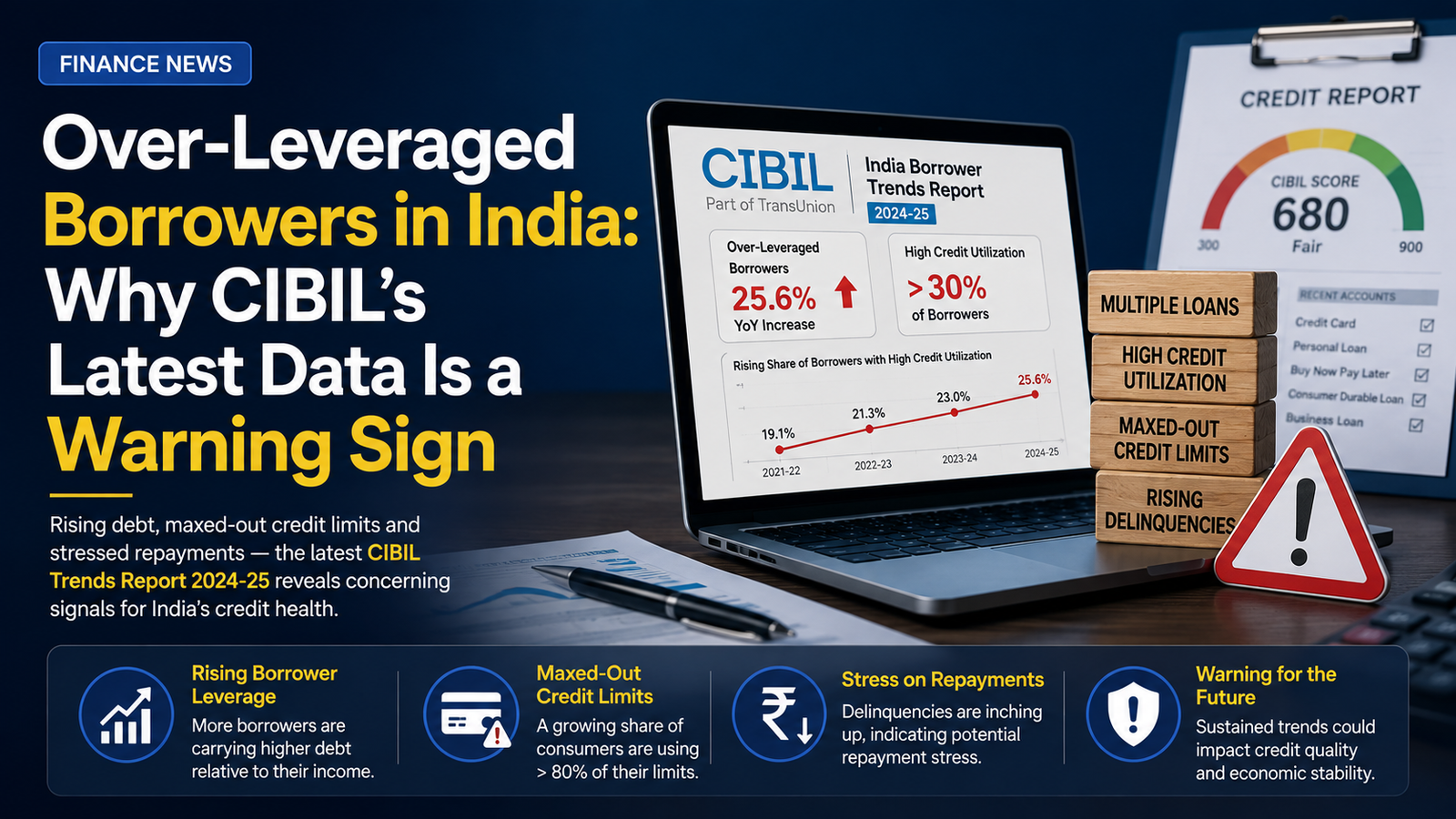
India’s retail lending market has expanded rapidly over the past few years, driven by easy access to personal loans, credit cards, and digital lending platforms. However, the latest CIBIL data suggests that this growth is beginning to slow, while the number of over-leveraged borrowers has reportedly increased three-fold.
The trend raises concerns not only for individual borrowers but also for banks, NBFCs, and policymakers. As more consumers rely on multiple unsecured loans to meet everyday expenses, the risk of missed repayments and rising defaults increases. This is one reason the Reserve Bank of India (RBI) has been closely monitoring unsecured lending and encouraging lenders to adopt more cautious lending practices.
What Does “Over-Leveraged Borrowers” Mean?
An over-leveraged borrower is someone who has taken on more debt than they can comfortably repay.
This often happens when a person has:
- Multiple personal loans
- Several active credit cards
- Consumer durable loans
- Buy Now, Pay Later (BNPL) obligations
- High monthly EMIs compared to income
When a large portion of monthly income goes toward loan repayments, even a small financial setback such as job loss or medical expenses can make repayments difficult.
What Does the Latest CIBIL Data Indicate?
According to recent CIBIL findings, two major trends are emerging:
- Retail credit growth is slowing after several years of strong expansion.
- The number of over-leveraged borrowers has increased significantly, indicating that many consumers are carrying higher debt burdens than before.
While credit demand remains healthy, lenders are becoming more selective as concerns over repayment capacity grow.
Why Are More Indians Becoming Over-Leveraged?
Several factors have contributed to the rise in household debt.
Easy Access to Personal Loans
Digital lending platforms and instant loan apps have made borrowing easier than ever. Many borrowers can now receive personal loans within minutes with minimal paperwork.
Rising Credit Card Usage
Credit card spending has increased rapidly as consumers use cards for shopping, travel, dining, and everyday expenses. If balances are not paid in full each month, interest charges can quickly accumulate.
Multiple Loan Products
Many borrowers simultaneously hold:
- Personal loans
- Credit cards
- Education loans
- Vehicle loans
- Consumer durable financing
- Buy Now, Pay Later accounts
Individually, each loan may appear manageable. Combined, they can create significant financial pressure.
Lifestyle Inflation
Higher incomes have encouraged greater spending, but in some cases, borrowing has grown faster than earnings. Financing discretionary purchases through debt increases repayment risks.
Why Is This a Concern for Banks?
Banks earn interest from lending, but rising borrower stress can eventually affect asset quality.
Higher Default Risk
Borrowers with multiple unsecured loans are generally more vulnerable to repayment difficulties during economic slowdowns.
Rising NPAs
If borrowers fail to repay their loans, lenders may see an increase in Non-Performing Assets (NPAs), affecting profitability.
Increased Credit Costs
Banks may need to set aside more provisions for potential loan losses, reducing overall earnings.
Tighter Lending Standards
As risks increase, lenders often respond by approving fewer loans or charging higher interest rates.
Why Is Unsecured Lending Under the RBI’s Watch?
Unlike home or vehicle loans, unsecured loans do not require collateral.
This means banks cannot recover losses by selling pledged assets if borrowers default.
Recognizing the rapid growth in unsecured credit, the RBI has already introduced measures in recent years to encourage banks and NBFCs to maintain stronger capital buffers against these loans. The central bank has repeatedly emphasized prudent lending standards and responsible credit assessment.
How Could the RBI Respond?
If borrower stress continues to increase, the RBI may consider additional measures such as:
Stricter Lending Norms
Banks may be required to conduct more detailed affordability checks before approving unsecured loans.
Higher Capital Requirements
Lenders may need to hold additional capital against riskier unsecured loan portfolios.
Enhanced Monitoring
The RBI could increase supervision of rapidly growing loan segments, particularly personal loans and credit cards.
Responsible Lending Guidelines
Further emphasis may be placed on preventing excessive borrowing and improving borrower disclosures.
What Should Borrowers Do?
Borrowing is not inherently risky when managed responsibly.
Consumers should consider the following:
- Avoid taking multiple personal loans at the same time.
- Pay credit card bills in full whenever possible.
- Maintain a healthy credit score by making timely repayments.
- Keep total EMI obligations within a manageable share of monthly income.
- Build an emergency fund instead of relying on debt for unexpected expenses.
Responsible borrowing improves financial stability and supports long-term creditworthiness.
Does This Mean a Credit Crisis Is Coming?
Not necessarily.
India’s banking system remains significantly stronger than during previous periods of financial stress, with improved capital positions and better regulatory oversight.
However, the sharp increase in over-leveraged borrowers serves as an early warning that household debt deserves close attention. If borrowing continues to outpace income growth, repayment pressures could gradually increase across the financial system.
The key challenge is maintaining healthy credit growth without encouraging excessive risk-taking.
Final Thoughts
The latest CIBIL data highlights an important shift in India’s retail lending landscape. While credit demand remains strong, the rapid rise in over-leveraged borrowers suggests that many households are carrying higher levels of unsecured debt than before.
For banks, this means maintaining disciplined lending standards. For regulators, it reinforces the need for continued oversight of unsecured credit. For consumers, the message is straightforward: borrowing should support financial goals, not create long-term financial stress.
As India’s credit market continues to expand, sustainable lending practices will be essential to protecting both borrowers and the broader financial system.
FAQ
What is an over-leveraged borrower?
An over-leveraged borrower is someone whose debt obligations are so high that repaying loans becomes difficult relative to their income.
Why is CIBIL’s latest data important?
The data suggests that retail credit growth is slowing while more borrowers are carrying excessive debt, indicating rising financial stress in parts of the consumer lending market.
Why are personal loans and credit cards considered risky?
They are unsecured loans, meaning they are not backed by collateral. This increases the risk for lenders if borrowers fail to repay.
How does rising household debt affect banks?
Higher borrower stress can increase defaults, raise provisioning requirements, and impact banks’ asset quality and profitability.
What can borrowers do to avoid becoming over-leveraged?
Borrow responsibly, avoid unnecessary loans, pay EMIs and credit card bills on time, and ensure monthly debt repayments remain within affordable limits.
